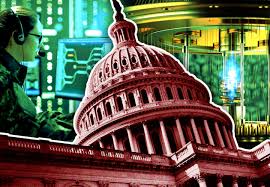
Quantum Is Already in Government Planning — Not Just Research Labs
Both the United States and China are investing heavily at the national level in quantum technology — signaling that governments are already positioning for real-world use, even if large-scale deployment is still ahead.
- A U.S. federal advisory panel has urged Congress to adopt a “Quantum First” national goal by 2030, recognizing quantum computing, quantum communications and post-quantum security as strategic priorities essential for future economic and military competitiveness.
- China’s upcoming Five-Year Plan places quantum technology at the top of priority future industries, with targets to build a high-qubit quantum computing control system and advanced infrastructure by 2026.
These aren’t academic exercises — they are policy roadmaps toward operational quantum systems.
What Governments Are Using Now
1. Quantum Communication and Cryptography
China already operates parts of the world’s most advanced quantum communication network. Its national backbone combining fiber-optics and satellite links has been deployed across thousands of kilometers, and is being expanded toward global reach with future satellites planned.
This application — quantum key distribution (QKD) — is a very early real-world government use of quantum principles. While it doesn’t require full quantum computers, it uses quantum physics to secure data and protect communications.
The U.S., Europe, and other governments are also investing in quantum communications and post-quantum encryption standards so that national security systems remain secure once quantum computers become capable of breaking classical encryption.
When Will Quantum Computers Be Used for Government Workloads?
There’s a wide range of expert forecasts, but credible research points to the 2030s as the era when quantum computing moves from research to practical use — with specific timelines for different types of application:
• Cryptography & Security
The U.S. intelligence community does not expect quantum computers to break current encryption standards before the early 2030s, though some analysts suggest breakthrough possibilities could arise sooner.
Governments are already planning upgrades to post-quantum cryptography — the set of security standards designed to withstand quantum attacks — because transition processes for critical infrastructure can take years.
• Specialized Government Problems
Fields like materials science, defense simulations, or national risk modeling could see hybrid quantum-classical systems deployed in the late 2020s or early 2030s — long before universal quantum computers exist.
Investors and government planners alike view this as the earliest phase of application: narrow advantage on specific high-value tasks rather than sweeping general replacement of classical systems.
• Large-Scale, Fault-Tolerant Quantum Systems
A fully realized quantum computer capable of replacing traditional cryptography or outperforming classical systems on broad tasks is still expected to materialize between the late 2020s and 2030s at the earliest. Industry insiders and technical roadmaps from major firms suggest quantum utility may emerge around this timeline, though the exact year remains uncertain.
Are Governments Using Quantum Now? Yes — in Incremental Ways
Although we are not yet in a world where national systems run on quantum computers, governments are already integrating quantum technologies:
- China has operational quantum communication infrastructure and is pushing toward global quantum networking.
- The United States has significant federal funding programs, research centers, national labs, and strategic initiatives seeking quantum advantage.
- Early deployment is happening in secure communications, research supercomputing collaboration, cryptographic planning, and defense modeling — not flashy consumer-ready systems, but mission-critical capabilities.
Why Governments Are Moving Now
There are two major strategic drivers:
1. National Security
Quantum computing has implications for cybersecurity, encryption, intelligence, and defense infrastructure. Governments want to avoid strategic surprise — being vulnerable when adversaries deploy quantum-enabled code-breaking or secure communication networks first.
2. Economic and Geopolitical Power
Both the U.S. and China see leadership in quantum technology as central to future economic and technological dominance. Whoever controls quantum computing and its secure applications could shape encryption standards, data security regimes, financial infrastructure, and AI integration for decades.
This is why quantum investment isn’t just private sector — it’s government-driven national strategy.
Bottom Line: Early Use Is Already Happening — Broad Impact Is Ahead
- Governments already use elements of quantum technology today — especially in quantum communication and early cryptography systems.
- Broad applications — like cryptographic relevance, national security optimization, and industrial disruption — are likely to emerge in the late 2020s to 2030.
- Full mainstream quantum computing adoption for everyday financial or economic systems remains a longer-term horizon, but infrastructure and policies are being built now.
In essence, the quantum transition is already underway at the government level — not as fully deployed systems, but as strategic capabilities that will cascade into broader financial, economic, and security domains over the coming decade.