

Quantum Computing vs Blockchain Technology: Understanding the Differences and Synergies
Quantum computing and blockchain technology are two of the most transformative innovations in technology today, but they operate in very different domains and serve distinct purposes. Understanding their differences, potential interactions, and implications for finance and crypto is crucial for professionals, investors, and enthusiasts alike.
1. Definition and Core Concept
Quantum Computing relies on the principles of quantum mechanics. Unlike classical computers, which use bits as 0 or 1, quantum computers use qubits that can exist in multiple states simultaneously through a property called superposition. Combined with entanglement, qubits can process vast amounts of information simultaneously, enabling solutions to complex problems far faster than traditional systems. Quantum computing is particularly suited for tasks like optimization, cryptography, AI simulations, and advanced financial modeling.
Blockchain Technology, on the other hand, is a decentralized ledger system designed to store and verify data securely. Transactions are grouped into blocks, which are cryptographically linked to one another, forming an immutable chain. Blockchain ensures trust without a central authority, powering cryptocurrencies, smart contracts, supply chain tracking, and secure voting systems.
The key distinction is that quantum computing is a computation method, while blockchain is a data storage and verification technology. One focuses on speed and problem-solving, the other on security, transparency, and immutability.
2. Purpose and Applications
Quantum computing excels in solving problems that are computationally intensive or require evaluating many possibilities simultaneously. In finance, it can optimize portfolios, detect fraud, forecast market trends, and even simulate risk models more efficiently than classical systems. In science, it accelerates drug discovery and climate modeling.
Blockchain, by contrast, is used to create secure, tamper-proof records. Its applications span cryptocurrencies like Bitcoin and Ethereum, cross-border payments, decentralized finance (DeFi), smart contracts, and secure identity verification. Blockchain’s primary value is trustless security and transparency, rather than computational speed.
3. Security Implications
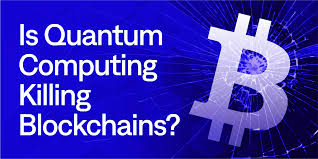
A major intersection of quantum computing and blockchain lies in security. Most blockchain networks rely on classical cryptography (like RSA and elliptic curve algorithms) to secure transactions. While currently robust against conventional computers, these methods could become vulnerable to quantum attacks in the future. Quantum algorithms, such as Shor’s algorithm, could theoretically derive private keys from public addresses, compromising crypto wallets and blockchain security.
However, quantum computing also offers opportunities for enhancing security. Researchers are developing quantum-resistant cryptography and hash-based signature schemes that blockchain platforms can adopt to protect against future quantum threats. Quantum random number generators could also produce truly unpredictable keys, strengthening wallet and transaction security.
4. Synergy and Future Outlook
Although they are different technologies, quantum computing and blockchain can complement each other. Quantum computing can enhance blockchain by optimizing transaction validation, improving consensus protocols, and enabling faster, more secure networks. Blockchain provides a practical framework for applying quantum-safe cryptography in real-world financial and supply chain applications.
In the coming decade, these two technologies may converge in areas like quantum-resistant cryptocurrencies, secure decentralized finance, and optimized financial networks, ensuring that blockchain remains secure even in the quantum era.
Conclusion
Quantum computing and blockchain technology serve different but complementary roles. Blockchain secures and verifies data, while quantum computing accelerates computation and can challenge or strengthen cryptography. Together, they represent the next frontier in finance, cryptocurrency security, and digital innovation, making it critical for investors, technologists, and professionals to stay informed.

Hi, this is a comment.
To get started with moderating, editing, and deleting comments, please visit the Comments screen in the dashboard.
Commenter avatars come from Gravatar.